
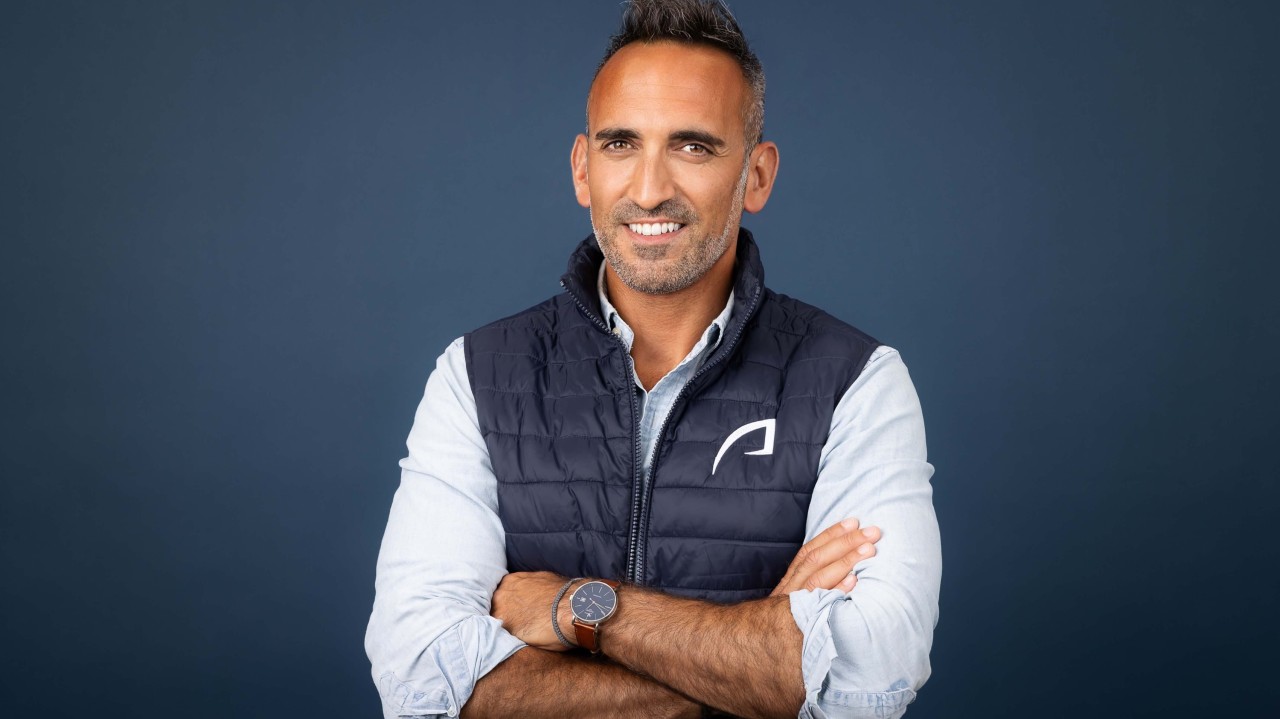
Cyrille Kabbara is the founder of Shark Robotics, a European leader in ground robotics for hostile environments. With a background combining economic intelligence and experience in special-forces intelligence, he has turned a technological vision into concrete solutions for civil and military security. Under his leadership, the La Rochelle-based company gained international recognition thanks to Colossus, the firefighting robot made famous by its decisive intervention during the Notre-Dame de Paris fire in 2019. Cyrille Kabbara advocates field-driven, highly responsive innovation that aims to "augment" humans rather than replace them, while preserving French industrial sovereignty.
Interview by Jean-Claude Galli
OASE: Volodymyr Zelensky recently claimed a first 100% robotic victory in the war in Ukraine. What can you tell us about that?
Cyrille Kabbara: It is a strong demonstration of the importance robotic capability has now taken on the battlefield. A ground robot seized a Russian position without any human being sent into what is called the Kill Zone - an area about 15 kilometres wide, saturated with drones, where moving forward is extremely difficult.
But that is only the tip of the iceberg. The reality of the robotisation of the Ukrainian theatre of war today is above all resupply, logistics and casualty evacuation. In 2025, nearly 30,000 ground robots were deployed on the Ukrainian side. They moved some 70,000 tonnes of freight into the Kill Zone: water, food, medicine, ammunition. That is enormous.
So 85% of missions are logistical or CASEVAC missions. The remaining 15% are combat missions: counter-mine operations, mine-laying or barbed-wire deployment. These operations have become extremely dangerous because drones are everywhere. They are carried out with small, fast, manoeuvrable robots weighing between 200 and 900 kilos, with a limited logistical footprint, that can be brought to the front in a simple van or small truck. The Ukrainian experience teaches us that anything big, heavy and imposing is very quickly destroyed, either by drones or at long range by anti-tank missiles.
"Massification is both an operational and an economic issue"
OASE: The robotisation of conflicts seems inevitable. Yet the subject appears absent from the update to the Military Programming Law (LPM). How do you explain this omission?
C.K.: In the LPM update, robotics is indeed not mentioned, or barely mentioned. It only appears in the subsection devoted to artificial intelligence. It is not treated from the angle of standardisation, but from the angle of interoperability, notably through the Pendragon programme. This experimental programme aims to make several robots autonomous so they can work collaboratively. It is a very good project, but it sets out a technological roadmap that will take 5 to 15 years.
The problem is that if, as the Chief of the Defence Staff says, we must prepare for conflict by 2030, today's robots will fight that war. In Ukraine, 100% of robots - I do mean 100% - are teleoperated. There is no autonomy or AI involved. In modern attrition warfare, what you need is robustness, reliability, repairability and low cost. A robot's lifespan in the Kill Zone can be 20 to 30 minutes; sometimes it can survive a few days, but no more.
We therefore need massification of this equipment. The standard doctrine in our armed forces assumes that last-mile logistics are carried out by a jeep, truck or armoured vehicle. That no longer works. Take any vehicle, a VBL or a P4 for instance, put it in the Kill Zone, and it will be destroyed in five minutes.
That is the operational aspect. Returning to the 70,000 tonnes of freight moved by robots on the Ukrainian front in 2025 also illustrates the economic and human dimensions. Broadly speaking, 70 ground robots cost the same as one armoured vehicle such as a VAB or a SERVAL-range VBMR. If your armoured vehicle is destroyed after five minutes, you have lost a lot of money and, above all, men. If you lose two robots out of 70, you still have 68 left to continue the mission, with no human losses. Massification is therefore also an economic issue.
What is regrettable in the LPM today is that it reflects a French army that continues to fight with an expeditionary model, as in Africa or Afghanistan. In other words: I have a bit of everything, I am good at everything, but I have no capacity for massification. The mistake, in my view, is to want to duplicate that model in robotics, especially by looking at it through the lens of heavy programmes such as the Rafale or the aircraft carrier, with a 15- or 20-year vision. That does not work in robotics, where technological leaps occur every two or three months. And they are not even disruptive technological leaps but, as the Ukrainians do, innovation leaps: the technique of small steps. We are talking about responsive innovation.
"We must impose industrial offsets on Ukraine"
OASE: The EU is preparing to unlock 90 billion euros in aid for Ukraine, a large part of which will be used to purchase military equipment. It is estimated that 80% of the weapons bought will be American. How does the French manufacturer of ground robots that you are react to this?
C.K.: Today, there is no control and little monitoring of how the capital given to Ukraine is used. No offset is imposed on Kyiv that would require it, for example, to contract with EU companies. Yet there should be monitoring indicators, a return on the capital granted, or performance KPIs requiring joint ventures between European and Ukrainian companies (*).
We can see this clearly in robotics and drones, where the Ukrainian defence-industrial ecosystem is developing thanks to massive EU funds without any offset for French and European industries. Everyone is free to use that money as they see fit. Unfortunately, American companies are sometimes better placed technologically, better placed in their ability to mass-produce and industrialise, and the Ukrainians quickly turn to them.
In return, we should ask for cooperation agreements, impose a European preference and even a European obligation. It is still regrettable that three quarters of this capital should benefit Uncle Sam. We must not forget that this money is our taxes.
OASE: Perhaps the lack of constraints enjoyed by the Ukrainians can be explained by the fact that some EU countries also prefer to retain complete freedom to buy American...
C.K.: There is still a sense of awakening, a jolt, especially in Eastern European countries. The instability of the Trump administration, which says "I protect you, I no longer protect you...", this unpredictability, is worrying. Countries such as Poland, which historically buy American to benefit from the umbrella that comes with it, are saying to themselves: "If tomorrow I no longer have Uncle Sam, who can I count on?" Only Europe remains.
(*) Shark Robotics has just signed a memorandum of understanding with Tencore, one of Ukraine's leading combat-robotics players. The partnership provides for the creation of two joint ventures. One, located in France, will focus on the development and production of defence robots based on battlefield experience in Ukraine. The second, based in Ukraine, will focus on civil robotics for security applications.